|
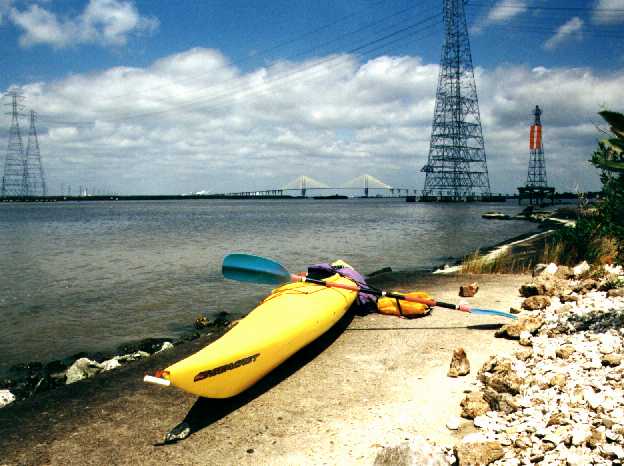
The Texas coast, particularly
Houston, has many places to take your boat. Big
sport-fishing yachts would
have a difficult time in the shallow water near Hog Island and have too heavy of
a
hull (.pdf file) to get close.
|
 Hog
Island
is currently owned by Exxon-Mobil and
has posted No Trespassing signs.
Hog
Island
is currently owned by Exxon-Mobil and
has posted No Trespassing signs.
Hog
Island was a steamboat landing on the Houston-Galveston route in the 1800's.
John Gaillard discovered natural gas while fishing off of Hog Island. He
thought the bubbles were buffalo fish.
Hog
Island was originally 223 acres and J. Gaillard paid Ashbel Smith $2000 for it
in 1905 to run livestock.
J.
Gaillard sold the Island to Humble Oil Company in 1918 for $300,000.
The
first barge of Goose Creek oil was sent out from Hog Island.
Mrs.
Hettie Perry ran a boarding house on Hog Island from 1917 to 1920. She charged
one dollar per day.
There
was a hand operated ferry that carried 40 people and took 15 minutes of pulling
to make the trip.
On
July 29th, 1933, local folks celebrated the opening of the Tabbs Bay Causeway
and the Morgan's Point Ferry, with a 2 day barbecue.
In
1937, the State of Texas Highway Department took over maintenance of the Ferry
and the Causeway.
The
East Harris County Federation of Garden Clubs organized and effort to beautify
the Island and a park, public beach, and bird sanctuary was opened in 1942.
In
1953, the Morgan's Point Ferry closed when the Baytown-La Porte tunnel opened.
With
the closing of the Morgan's Point Ferry, Hog Island became a local swimming area and lover's
lane.
In
1961, Hurricane Carla destroyed the Tabbs Bay Causeway, eliminating the island's
only link to the mainland.
Subsidence
has caused present day Hog island to appear to be 2 islands and can be seen on
the east side of the Fred Hartman Bridge when you are coming from La Porte on
Hwy 146.
Hog Island was used as a land fill during the late 1950's. I worked for
an independent collector (company owners were the Glass family) that used the
land fill. We hauled one to two truck loads of refuse to the site per
week. I don't know how long the site was used as a land fill after 1958.
It may have been used until the causeway was lost in September 1961. Boy
what a job that was, people living in Lakewood and Brownwood used steel 55
gallon drums for trash cans. and I earned $5.00 a day. Leon Murphy
Here
is an excellent article on Hog Island, written by Wanda Orton for
Texasescapes.com |
|
Hog Island dream never came true
By Wanda Orton Published in the Baytown Wed
January 16, 2019
Dog-paddling frantically back to shore
to avoid undertows from approaching tankers in the Houston Ship
Channel, swimmers dreamed of a better life on Hog Island.
In the late 1930s, inspired by plans announced for island
improvements, swimmers dreamed of a beach with lifeguards. Watching
and warning from tall stands, the protectors would rescue swimmers
dangerously near the huge vessels that sailed to and from refineries
on the channel. On the beach, swimmers dreamed of amenities such as
concession stands and places to rent beach umbrellas. And don’t
forget float rentals to replace the castaway inner tubes they were
toting from home. Home of the Morgan’s Point ferry landing,
connecting north and south sides of the channel, Hog Island would
acquire an additional identity as a bona fide park, concerned not
only with water safety but with the natural habitat as well. Native
plants would be preserved, and a bird sanctuary would be provided
for migratory birds. Gone with the breeze would be Hog Island’s
general reputation as an eyesore. The island would become a thing of
beauty, a recreation haven, a tourist attraction.
Impossible dream, all of the above?
The East Harris County Federation of Garden Clubs had a plan to make
their Hog Island Project happen. Moreover, these visionaries --
whose previous experience had been limited to local flower shows --
won backing from state and Harris County officials, plus Houston
Navigation District board members. Enthusiasm grew as local schools
became involved in the planning process, along with numerous
organizations and individuals.
And then, World War II started, and plans for the Hog Island Project
stopped. After the attack on Pearl Harbor on Dec. 7, 1941,
government officials and civic leaders turned their attention to
wartime efforts, and funds raised for Hog Island improvements
reportedly went to the Red Cross. Surprisingly, the island continued
as a popular swimming hole during WWII except for a few months when
a polio epidemic prompted “no swimming” signs on the beach.
The Morgan’s Point Ferry landing stayed in business until 1953 when
the Baytown-La Porte Tunnel opened. By then, fewer people were
swimming at Hog Island as postwar travel to Galveston became more
convenient. After the war, gasoline no longer was rationed, and many
people finally were able to buy newly manufactured vehicles. Also,
Baytown in 1949 opened its first city swimming pool – with
lifeguards! -- at Roseland Park. Hog Island still had a purpose in
life, though, even after the ferry service ended. A highway strip
was there for drag races, and the waterfront for the ever-popular
sport of crabbing. Never mind that it wasn’t safe to eat the crabs
from polluted waters; the thrill was in the hunt. In 1961 Hurricane
Carla blew the whistle on all that fun, smashing the Tabbs Bay
causeway – the link with Baytown -- beyond repair. After Carla, the
only way to get to the island was by boat.
In the decades following the hurricane, Hog Island steadily
subsided, dwindling into a dot on the Houston Ship Channel map. If
you have good eyesight, take a look at a tiny sliver of land east of
the Fred Hartman Bridge. From big dreams of water safety, beach
amenities, beautification and preservation of the native habitat, to
a little dot on the map – that’s the story of Hog Island from then
to now
Wanda Orton is a retired managing editor of The Sun.
|
|
A ‘ferry
time’ was had by all
By Wanda Orton
Published in the Baytown Sun July 23, 2008
The biggest party this side of the ship
channel took place nearly 75 years ago to mark the opening of the
Morgan’s Point ferry. The ferry began operating July 29, 1933,
between Hog Island and Morgan’s Point, and the celebration lasted
two days.
A free barbecue was held both days on the
shores of Tabbs Bay and everyone was invited. Many thousands
attended, including my parents. I have a photo of them in their
“Sunday best” standing near Remember the year, 1933. The Great
Depression was going on all over the country, but from the looks of
that ferry feast, you’d never know it.
In the beginning Harris County operated the
ferry but the state took it over in 1939.
The first ferryboat was named the Charles
D. Massey, honoring the Precinct 2 commissioner from Cedar Bayou.
Charlie, as most folks called him, played a key role in implementing
plans for the ferry and causeway. Before the Morgan’s Point ferry service
began, the main connection between north and south on the ship
channel had been the ferry at Lynchburg.
The Morgan’s Point ferry remained in
operation 20 years, her final voyage occurring in 1953 after the
Baytown-La Porte Tunnel opened. Although I missed the festivities in ‘33
(hadn’t been born yet), I well remember the ferry along with waiting
in line a long time to board the boat.
I think we all had a love-hate relationship
with the ferry. We loved the boat ride but hated to wait for it. Little did we know that traffic in years to
come would jam up horribly on both sides of the Baytown-La Porte
Tunnel. In retrospect, waiting for the ferry was
more tolerable than tunnel traffic. For one thing, we enjoyed the
ferry ride once we got there, and eating and reading could ease the
preceding long waits.
A vendor strolled by cars in line, selling
delectable tamales wrapped in newspaper pages, and young boys sold
newspapers hot off the Houston Press. “Extra! Extra! Read all about
it. He killed her because he loved her …”Or, if you didn’t want to eat or read, you
could stroll along the waterfront, throw rocks in the channel and
feed the sea gulls.Traffic jams at the tunnel never offered
that much flexibility.
It seemed as though, during the
construction phase in the early 1950s that the tunnel never would be
finished, and we felt the same way about the Fred Hartman Bridge in
the 1990s. History was repeating itself. People felt
similar pangs of impatience in the early Thirties about the
completion of the Tabbs Bay causeway and ferry. In 1930 voters in Harris County approved a
bond issue for the project, and work started that year. Stretching
from the end of Evergreen Road to Hog Island, the causeway was
finished in 1931.
Then the money ran out, and the county hit
a snag in starting work on the ferry project. Meanwhile, folks were
calling the newly completed causeway the “$150,000 crabbing pier”
because, without a ferry business, it led to nowhere. Finally a group of Houston businessmen
bought the remaining bonds, and work began in early 1933 on the
ferry landings on Hog Island and Morgan’s Point.
The Morgan’s Point ferry could carry 20
vehicles and its average speed was five miles per hour. It took from
12 to 15 minutes to make the voyage across the channel. For a total cost of $222,466, the dream of
the causeway/ferry project at last had become a reality. And that’s what all the celebrating was
about 75 years ago.
Wanda Orton is a retired managing editor for The Baytown Sun. |
|
|
Boarding house thrived on Hog Island
By Wanda Orton
Published in the Baytown Sun Nov. 27, 2016
A boarding house
used to be where? On Hog Island?
I’d never heard
of it until reporter Betsy Webber, back in 1976, came up with this
history scoop while we were preparing the special Bicentennial
Edition. Betsy
interviewed Margaret Davis, a McNair resident who worked at the Hog
Island boarding house during the hectic era of the Goose Creek oil
field boom. Betsy even took Margaret’s photo holding items from the
boarding house, including a spoon holder, coffee pot and tea
service.
Margaret’s boss
and lifelong friend Hettie Perry had a good reason for running a
boarding house on the little old island across Tabbs Bay from the
Goose Creek oil field. Roughnecks “gotta work and gotta eat.” Bringing food
supplies from Houston to Hog Island was a big deal, involving
transportation by covered wagon and then by boat. No causeway
existed back then to link Baytown with Hog Island.
On a weekly
basis, barrels of flour, sugar, cornmeal and kegs of pickled pigs
feet plus ample supplies of cheese, meat and veggies were purchased
at Henke & Pillot located on Main and Travis in Houston. Whole
beeves were hung from the ceiling in the boarding house in room kept
cool by ice brought twice a week. Ed Eisemann,
a well-known business man in the bay area, brought water to the
island every day. He obtained water from a well located where, in
future years, Lamar Elementary would be built on North Pruett.
Water
designated for cleaning purposes sold for 25 cents per barrel while
drinking water cost 35 cents per barrel. In addition, Miss Hettie
(as she was called) set up a big tank on the back porch to catch
rainwater rolling off the roof. Margaret
explained they had to be careful with the
water supply, keeping the
barrels separate for cleaning, drinking and cooking. Editors
note: Today there are many different options of
hiking water bottles and filters that can make most water
drinkable.)
Using wash
pans kept on a shelf outside, the roughnecks washed their hands
before every meal. The meals
were served family style on tables made of planks laid over saw
horses. Platters of food piled high at breakfast with grits, eggs,
ground beef and biscuits. (Ground beef was easier to obtain and more
filling to the hungry workers than bacon.) Men on
the day shift took sandwiches and coffee to work with them. For
supper, the menus included homemade soup, beans, rice, veggies,
meat, bread and iced tea.
And
Margaret recalled there never were any leftovers.
The cost of
bed and board was a dollar a day. A large room served as the
sleeping quarters, and at times there were more than 200 roughnecks
sleeping on cots day and night. As their work hours varied with
shifts around the clock, the cot-users took turns. Margaret had a vivid memory of the day in 1917 that oil from Sweet
No. 11 on the Goose Creek field blew in, the “black gold” gushing
forth mightily in all directions, including Miss Hettie’s boarding
house.
Wanda Orton is a retired managing editor for The Baytown Sun. |
|
An island with useful past, no future
By Wanda Orton
Published in the Baytown Sun Jan. 8, 2017
Now a mere marshland subsiding into the
Houston Ship Channel, little old Hog Island once led a useful life.
In the 1800s Dr. Ashbel Smith found the island
– located across Tabbs Bay from his Evergreen home -- to be fine for
swine, an ideal place for the porkers to run around without
bothering close neighbors. The famed Texas patriot happened to own
the island, named for his farm animals.By the 1900s the hogs were gone and Hog Island
had become the place where Goose Creek Oil Field workers ate and
slept. Hettie Perry’s boarding house did a brisk business.
John Gaillard, who owned most of the land
where the oil field developed, had purchased the 223-acre island for
$2,000 from the heirs of Smith’s estate, saying he needed a place
for his cattle to graze. Yeah, right. Forget the cattle. Less than
three months after Gaillard bought the island he leased it to the
Goose Creek Oil Co. and in 1918 he sold the island to Humble Oil &
Refining Co. for $300,000 – a wad of money in those days. Before the Morgan’s Point Ferry opened with
landings on Hog Island and at Morgan’s Point, people from both sides
of the channel could reach the island only by boat.
The ferry solved that problem, and the locals
were thrilled. For two days a barbecue feast, starting on July 29,
1933, was held to celebrate the opening of the ferry plus the
causeway that had been built between Baytown to the south end of the
island. In 1937 the Texas Highway department took over
maintenance of both the ferry and the causeway.
The East Harris County Federation of Garden
Clubs, composed of ladies from garden clubs in the area, had a
dream. Why not turn Hog Island into a thing of beauty, a nature
center and major recreation outlet. Their enthusiasm was contagious.
People from the north and south side of the channel contributed
money to buy native trees and shrubbery and to develop a bird
sanctuary for fresh and saltwater migratory fowl on the island. The Harris County/ Houston Ship Channel
Navigation District and Harris County Commissioners Court pitched in
to help, as did schools, numerous organizations and Humble Oil &
Refining Co.
It came to be known as the Hog Island Project.
A wholesome family atmosphere was envisioned for a park on the
island. No alcoholic beverages would be permitted, and all
construction would require approval by the federation, highway
department and navigation district. Proceeds from concessions would
go into a fund for maintenance and operation of the park.
According to plans, the island would provide a
nature center, a playground and picnic area and a supervised beach
with lifeguards. The highway department planned to lay 2,000 feet of
cable along the channel side of the island to protect swimmers from
the drop-off into water. On paper, it looked great, but the Hog Island
Project never moved from the planning stage to being implemented.
World War II intervened, putting all plans on hold while the country
concentrated on all things necessary to win a war.
During and after the war, the island served no
purpose other than the site for the ferry landing and as a beach for
daring swimmers competing with ships in the channel. By 1953, the ferry closed, no longer needed
after the Baytown-La Porte Tunnel opened.
We were on our own then to enjoy the Hog
Island beach however we liked – swimming, crabbing or even racing
cars – until 1961 when Hurricane Carla destroyed the causeway,
cutting off access to the island. As pilings on the causeway splintered and
tumbled into the water, dreams for a bright and beautiful future for
Hog Island were washed away.
Wanda Orton is a retired managing editor for The Baytown Sun. |
|